We found this fellow in the bland surrounds of a European Delegation office building, tipped off by a comment made on the Port Vila "cruiser net", a VHF swap-and-meet for yachts in the anchorage. He was made to be worn over a man's head, resting on the shoulders or supported by the arms. The curvy bits coming out of his cheeks are pig tusks, apparently the most prized ornaments in customary Vanuatu society where, I gather, men value their pigs more than their wives (whose chief job is to look after the pigs).
He's a crude piece of work in my eyes, but when he and others like him, are seen en masse, they start to work on you, even in sterile air-conditioned surrounds. We were mesmerised by the exhibition Vanuatu-Oceania, 45 years of collecting. The artefacts in it, said to be rare, belong to an intriguing individual called Paul Gardissat, who reportedly once studied under Albert Camus in Algeria, and went on to spend 35 years in Vanuatu as a school principal and broadcaster. In size and in diversity, M. Gardissat's private collection far outstrips what we saw in the public collection of the Vanuatu Cultural Centre.
We've been told by experienced Vanuatu cruisers that once we leave Port Vila we'll be meeting many tribal people. We'll need to ask their permission to anchor our yacht in their waters - land rights in Vanuatu extend out to coral reefs which are reasonably regarded as a source of food and income. And we'll be relying on them to offer us food to buy or trade. Beyond knowing that we will be cruising on their terms, I have no idea of what our contacts with Ni-Vanuatu (as the people of Vanuatu are called) will be like. The people we've met in town - on the street, behind market stalls, driving a bus - have been friendly enough. The team at the marina (Lemara in the office, Hilary who does odd jobs and laundry, and Moses who runs the fuel dock and helps yachts with their lines) hasn't had an off day. They smile broadly, and they're efficient. That's a nice package.
There's survey kicking around which claims that Vanuatu is the happiest country in the world. In Vila, you hear familiar talk about idle youth and crime, kids not attending school, and how hard for families to make ends meet. I saw a tee-shirt on a young man reading "Vanuatu - no sweat, no money". Sounds like everywhere else I know. But this is still a mysterious country to me, and we're going out to see more.
We leave early tomorrow morning, and don't expect to have an internet connection again until we call into Luganville, the other town, on the northern island of Santo.
The stress levels on Kukka have been over the top. We’ve had power trouble. One of the biggest challenges for live-aboard sailors like us is keeping up with the demands of the mod cons. Ours are comparatively modest. We have a small fridge, and of course, our laptops and the array of navigation instruments now considered essential equipment, but we don’t have a television, a microwave oven, a washing machine or a freezer, all relatively commonplace on “serious” cruising yachts.
Like everyone who is disconnected from mains power, whether they be on land or at sea, we have to generate amps enough to stay out of trouble. There are only a few ways of doing this, and like most yachties we use a combination of solar and/or wind power, and fossil fuel to keep the batteries charged up. So if I say that we’ve had problems with both our wind generator, and our engine alternator, you’ll possibly appreciate why the charms of Port Vila are only slowly revealing themselves to us. We’ve spent far too much time looking inwards, and far too little looking at where we find ourselves.
We’re swinging from a mooring near IririkiIsland, a short dinghy ride from the seawall marina run by Yachting World. This is a pretty nice place to be stuck, and there’s even more to look at since the round-the-world ARC fleet came in during the weekend. Alex is beside himself with excitement since, as he says, all the major Swedish production boat builders are represented here in Port Vila. We are flanked by a sleek Hallberg-Rassy 42 and a Najad, and on the seawall there’s a Sweden Yachts 45, which is the raciest of them all. Who needs boat porn when there’s a live boat show happening around you?
I hurried along the Lini Highway to get to the market before it closed at noon on Saturday. There was a traffic jam along Port Vila’s dusty main drag, cars and minivans crawling nose to tail, people pouring out of town for the weekend, I presumed. I knew I wouldn’t have much choice of produce, but no less than any other day. People sell what they grow – bananas, yams, firewood, coconuts, kava root, pawpaws, citrus. If I wanted tomatoes or capsicum, I’d have to go to the supermarket. I walked back to the dinghy dock with 10 passionfruit, a small eggplant, a bunch of basil, two pink grapefruit, a green pawpaw, and sweet potatoes, the last packaged in a sweet little basket woven from fresh woven palm leaves.
The markets, open 24 hours a day during the week, are a window into another world which I can’t claim any understanding of yet. Port Vila is not the best place to start. It’s a town of 45,000 people, and one of only two towns in the whole of Vanuatu, where 80% of the population still live in villages of less than 50 people. Port Vila has ATMs and internet and a casino. The pharmacy is well stocked, and a few cafes have espresso machines (Vanuatu grows coffee). Still, it’s not so long since there was no town, just a generation or two ago, and the people you see here don’t feel like townspeople.
There’s been a rice shortage in Port Vila this past week, and the last 5 kg packets of Sun rice have been selling out “like hot tuluks”, according to Friday’s Daily Post. “Though some of us may hate to admit it, we are directly or indirectly dependent on rice,” the front page article said. In many homes, people don’t have gardens and can’t afford the steep prices of root crops, fruit and leafy greens at the main market (even I, with vatu spilling out of my wallet, don’t find the market particularly cheap). The Daily Post report ended philosophically; “But then, the best things in life do not come free and this is town life.”
Alex and I have walked up the hill at the back of the Lini Highway, and peered through the gate of the prime minister’s house, checked out the presidential palace and the parliament house. There’s a surprising amount of barbed wire around the perimeters of houses and schools and other institutions. I’m not sure how people who mostly still live under traditional communal rules understand private property, but the barbed wire suggests that there’s some tension there.
On the positive side of the ledger, when Vanuatu celebrates 30 years of independence on July 30, the Port Vila authorities are putting on a free public lunch after the Flag-raising. They are expecting to feed 40,000 people, the paper said. Who does that leave out?
So this is what all the fuss is about… the sheer pleasure of sailing day after night after day, under a benign sky and on a friendly ocean. This time, it happened the way I’d been told it could happen. The nights weren’t terrifying, not even arduous. They were exhilarating, both of them, as we whooshed north, leaving behind the weather forecast in French and heading for a place which, as we approached it, felt a little bit like the Magic Isles, so enthusiastically had other yachties spoken about Vanuatu to us, and yet in such strange, and difficult to comprehend ways. How could it be that there still existed a place where commerce hadn’t found its way into every nook and cranny?
Destiny loving the sail from Noumea to the Baie de Prony , where we anchored overnight before leaving New Caledonia via the Havannah Passage
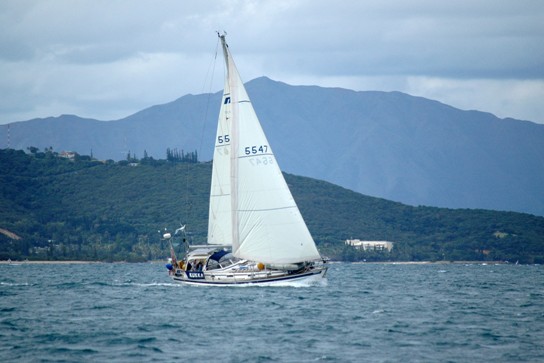
The first eight or so hours out from the New Caledonian coast were a bit quiet, with the breeze too light to sail, but once the wind freshened from the south, there was no looking back. Sure, we would have liked more east in it. Kukka doesn’t feel quite at ease with the wind and the swell up her backside. Destiny, on the other hand, grand lady of substance that she is, was in her element and during the first night, as we rounded Lifou, the middle island of the Loyalty group, she pulled away from us, and stayed about 10 miles ahead for the rest of the trip. But who was racing?
During the second night, when I was on watch from midnight to 4 am, and the moon came up and the stars shone hazily, I had such fun with Kukka. I relaxed into her. Not so much that I forgot how little I knew, and can actually do, but enough to take the edge off the anxiety which I had accumulated around night sailing. Until now, every night sail Alex and I have done has involved some degree of drama, with weather and sea state difficult and unpredictable. But not this time. When the wind shifted, I adjusted the angle of Kukka’s course to the wind (our clever autopilot allows us to set a course by wind angle, if we so desire – it can mean you sail a few more miles if the wind is not steady, but on balance, we have found that we keep pretty much to the same line as Destiny, who sails to a compass course). When it shifted back, I shifted course again. I kept a check on the reefed sails, got the radar and AIS fired up when needed and I was on a roll!
Part of the relaxed feeling was also, undoubtedly, because I wasn’t bundled up in five or six layers of clothing. The air was so balmy. I still wore wet weather pants and a harness, but instead of a big stiff jacket I put a light fleece over my teeshirt, and instead of marine gumboots and thick hiking socks, I wore shoes and cotton ankle socks. I hooked myself up to the iPod and when sleep was dangerously close, bopped along to The Black Seeds, an Kiwi reggae/dub group guaranteed to stimulate your body rhythms.
When I was next awake, Kukka was still humming along and the skipper was blissed out on country music, his latest crush. There he was in the cockpit, likewise hooked up to the iPod, playing air guitar and air drums and singing his heart out to the soundtrack to the dJeff Bridges movie Crazy Heart. Priceless. There was a moment when we looked at each other, and smiled, very big smiles. The speed dial read 7.6 knots ( a very satisfactory speed indeed). The wind had finally come round more into the east, and Kukka was like a frisky horse, shaking her head and kicking up her heels. It was a beautiful morning, and at this rate, we worked out as we ate our muesli, we would arrive in Port Vila in the late afternoon, before dark. We don’t like anchoring in the dark.
When we’d finished breakfast, it was Alex's turn to go down below for a nap. I gave him the fruit scraps to throw overboard - banana peel, pear core and passionfruit shells - and as he remembers it, in his sleepy state, he absentmindedly began picking up small round objects from the deck and throwing them into the ocean, passionfruit seeds, probably, or seeds that birds had crapped out. Suddenly, he clicked out of his reverie, and leapt.out of the cockpit, with expletives. The proverbial penny dropped. There were no birds around, and passionfruit seeds didn’t look like that, did they? These things were nylon ball bearings. Where the **** had they come from?
They’d come from the traveler car which, for the layman, is plastic moulding around a steel frame, loaded with ball bearings, and designed to slide across the deck on a track, taking the whole load of the mainsail and the wind that is in it. The said mainsheet car was now two feet in the air, held only and fortuitously, by what remained of a disintegrated traveler car, minus its ball bearings, and one of its end pieces through which the ball bearings had escaped. The morning suddenly looked quite different, much less secure. On the sea, things can change very quickly if you don’t pay attention.
What to do? How do you fix it? Can you fix it? First, he had to control the boom before it wreaked further havoc. He lashed it to a strong point on the deck, then he had a Coke and a fag, and engaged the brain.
Alex is a squirrel. It’s a trait of his that I frequently berate him for, but on this occasion, I have to say, Squirrels Rule. He went foraging in the forepeak and came out with a recycled hospital carry-bag full of hardware. Fossicking among the relics, he struck gold - a spinnaker block, circa 1986, once belonging to Slack Alice (his J24 boat). He untangled the broken bits and the mainsheet, and removed them from the disabled system, while keeping the boat sailing and stable in all that lovely boisterous wind we’d been enjoying up until then. Then, matching the ex-J24 block with an assortment of shackles and pins, over the course of the next hour he assembled a workable replacement for the busted car. Quite pleased with himself, he was too. “This could take us around the world,” he said, of his contraption. I didn’t doubt him. Bernard Moitessier sailed around the world twice in a boat with a mast made from a second-hand telegraph pole.
We arrived in Port Vila at dusk, and made for the quarantine buoy, the nominated area for yachts awaiting clearance. In fast fading light, we failed to get the anchor to hold on the sand and coral bottom. Our second attempt, by torchlight, succeeded – whew! Watching new arrivals anchor and re-anchor is always great sport for other yachties swinging on their already well dug-in hooks. Smug of countenance, none of them at that instant would care to recall how often they’ve been the object of such prurient attention. The next morning though, all is forgotten. There’s a town over there coming alive, and a cruise ship gliding in through the harbour entrance. Port Vila already seems like a town I want to get to know.
Today we leave the friendly, but rotten smelling marina at Port Moselle, and head south to pass first through the Canal Woodin and then through the Havannah Passage to reach the open waters on New Caledonia's eastern coast. We're bound for Vanuatu. It seems at this stage as though we'll be bypassing the intriguing, volcanic island of Tanna, the southernmost entry point for Vanuatu, for two reasons. First, the swell in Port Resolution looks as though it will be too big for comfort and second, by unhappy coincidence, a large number of round-the-world rally yachts arrive just as we were planning to drop anchor. They will be busily engaged in taking all available anchoring spots, depleting the stores of all their goods and generally raising the prices of what is left in this tiny settlement. Rally participants are notorious for their anti-social attitude towards other cruisers, so Port Vila it is - as far as we know.
The weather promises a smooth ride (though you didn't hear it from us).
This is like a last gasper, the blog entry you write when you're embarking on a long-haul knowing that your habit is going to cause you a fair bit of grief. Frankly, I'm surprised at how tetchy I've been getting when the link with the online world is down, even when I understand the reasons why. Wasn't I the one who was going to sea with a library of high-brow books and Scrabble for a change of pace? Ah yes, but the unspoken assumption behind this arcane position was that it would be underpinned by fast and reliable internet access. I had to be dreaming..
.
Lagoon sailing, under genoa and reefed main, en route to Ilot Amadee and leaving behind us the cloud-attracting mountain spine of the main island.
We've been floating around in the lagoon these past few days, never more than 12 nautical miles from the Big Smoke of Noumea. The seas have been calm, the trade winds fair (don't lose me here). How easy for those little signals to zip across the water, I'd find myself thinking. So why don't they? Well, it's all a question of dollars, I imagine. Just as, for obvious reasons, little Kukka is not equipped with all the communications bells and whistles that some of the bigger, more glamorous boats tied up on the same pontoon carry (Te Okupu, a high-end charter catamaran from Auckland, pops up on my screen as having its own wireless network), so small Pacific island nations make do with fewer, and slower, technology options. Duh. Cruising 101.
We have decided to clear out of Noumea tomorrow - that is, make the rounds of the customs and immigration offices and the capitaine du port and, finally, organise to buy duty-free diesel. On Saturday, all going well, we'll head out to the open sea again, bound for Vanuatu. It's not that we've got anything against New Caledonia. Far from it. The place is tailor-made for holidaying. We anchored off Ilot Maitre, a speck of land surrounded by a vast coral reef, only three miles from Noumea. The cute pseudo-thatched huts strung out over the water (below) belong to a resort.
Though the water at this time of year is cool (I gave my new full-length wet suit its first outing), there's nothing so idyllic as floating among and over multicoloured fish within easy reach of your very own boat. The situation was a little different at Ilot Amedee, another dot in the lagoon, with reputedly great snorkel and dive spots. Here, we were close to the opening in the reef which protects much of the southern part of New Caledonia's Grande Terre (main island). Ilot Amedee is famous for its beautiful lighthouse, which guides sailors (ourselves included) into the lagoon with its amazingly powerful beam. The French do like a tower, and this one, commissioned under Napoleon III (who remembers him?) and built in Paris in 1862, bolts together like a giant meccano set peppercorn grinder, so elegant and superior.
If I thought at all about Noumea before we came here, it was primarily as somewhere French. Baguettes in the tropics (not my legs walking towards the marina, below, but you get the picture).
The tricoleur flies from government buildings and the Blogger website pops up in French - et pourquoi pas? The petty officials who greeted us on our arrival had French attitude (gotta love those dark shades on the customs guy who insisted that Captain Wombat retrieve and count the 30 bottles of ultra cheap Venezuelan rum he stores in his bilge, and then, after re-counting the bottles himself - he's peering under the table to do so in the picture below - officiously sealed the floor opening to keep the pernicious drink in bond).
We’ve been here less than a week however, and I’m getting the distinct impression that this place is less French than I am.
La Vieille France in Rue Sebastopol is a very fine bakery and the Casino supermarket has all the delicacies one would expect to find on French soil but there’s something a bit weird, a bit jarring about the fit between the Pacific and Paris in Noumea. While the French keep a tight cultural rein on their dominion (I see no English-language magazines or newspapers in the news agency), the pungent earthiness of Kanak (indigenous) culture seems to push very hard against the French polish.
Crossing town on foot in the early evening, I pass the bus depot where throngs of brightly-patterned Mother Hubbard dresses (the distinctive, floppy smocks which women of a certain age wear, and which are a hang-over from missionary times) squeeze against each other on the benches. I see loose-jointed, dark-skinned women with weary faces. Swarming the road where the buses turn in, I see sullen-mouthed boys wearing the green, red and yellow insignia of freedom fighters (could that be Che Guevara on the back of his hoodie?) and young girls with lovely bright eyes jostling each other. And there are older men too, looking like they have all the time in the world and no-one to pay them for it. The majority of public transport users are Kanak. I wait to cross the three-lane express-way between the bus depot and Port Moselle, and notice that most of those driving cars are white.
Of course, I’m making a point. I’m not being objective, not behaving like a journalist (though the habit dies hard). I’m feeling my way into this town. My impression is of a drab, unloved outpost, held for strategic and economic reasons, and not much more. You can presumably live well here. We haven’t eaten off the boat, but I’m told that there are some good restaurants near the beach, and the views from smart houses in the better suburbs must be glorious. We saw Porsche and Audi dealerships near the airport. How their business relates to the currents of despair, insolence and subversion which swirl around me as I walk in the street, I can’t say. Perhaps I’m imagining this two-tier society, white on top, black on the bottom. Perhaps everyone feels part of one big happy French family. Or perhaps the French are keeping this colony (it probably has another, more politically correct name these days, but New Caledonia is part of the empire) by force. They will say it is not so, of course.
We caught a local bus out to the Tjibaou Cultural Centre (above) on the outskirts of town. Renzo Piano designed the building, and it’s an astounding structure, a little like coming across the Sydney Opera House in the corner of a public housing estate. The centre is deservedly famous, but it houses surprisingly little of substance. It cost France a packet to build (50 million euros) but when you realize that it was opened in 1998, only 10 years after the pro-independence Kanak leader for whom it was named was assassinated, the time frame seems hasty, like an overly generous gift to a widow. For some reason, it puts me in mind of the Memorial for Europe’s Murdered Jews in Berlin. Both monuments were significant political gestures on the part of the nations concerned, but you ask yourself what other purpose they serve... Aside from a small, interesting collection of contemporary art from the region, there’s not a lot at the Tjibaou centre to get your teeth into. Ironically, the few old ceremonial carvings on exhibit are all on loan from the Quai Branly in Paris. The Museum of New Caledonia, just across the road from the marina, has much more in the way of interesting artifacts, ancient and modern, but displayed with a curious lack of information. Dates, place names….who needs ‘em? Still, being a person who welcomes the help of cultural hand-grips, these were both good places to visit.
We’re heading out of the marina tomorrow – in the picture above, Kukka is on the left, beside Destiny (with the awning) and Wombat (with the big backside). The Boat Jobs are done. I have discovered that for yachties, being in port is synonymous not so much with getting to the movies but getting to the chandlery. Alex has had two new wind vane covers made for Humphrey - not up to Paris couture standards, sadly. I have loved the proximity of the central Noumea market to the marina (stubby green bananas like those pictured above are stowed on board). I’ve been buying fish - we're eating something called grisette tonight. I'll bake it in coconut milk, with freshly grated coconut, red onions, and sliced lime (I did the same last night, and it was a Culinary Triumph). If you could see the viscosity of the water in Port Moselle, and smell it, you’d understand there is no question of catching fish in here, since you were wondering. I am coming to terms with the limitations of internet use in this part of the world – we are at the edge of the known technological universe (as opposed to its hub). I understand from Destiny and Wombat that Noumea is as good as it gets, and I should count my blessings. We have bought a powerful little antenna, and I will hope for the best in the wireless department as we move out from the kir royale zone.
What a sail! We were seven days at sea. On six of the seven days, the wind blew like stink, the swell was muddled and at cross purposes, and if we weren’t taking great washes of water over our foredeck, we were being dumped on from above. On the seventh day, when the skies cleared, the wind dropped right off, the swell lengthened and the sea flattened, I had a much finer appreciation of the expression “keeping an even keel”. My first ocean passage wasn’t supposed to be like this, but what can you do? Deal with it, that’s what.
We sailed out of CoffsHarbour in high spirits just after midday on Saturday, June 12. With the blue hills of the mid-north coast interior growing smudgy, I rang the kids, and Mum, who was packing for her own foreign travels. The final goodbyes. Our prospects for a good passage looked bright, we thought. The over-size swell of the previous week was predicted to subside, robust winds from the south looked good for at least two or three days and all that was worrying the captain of Destiny, Dr John, was that by Wednesday, if the forecasts held, we would run out of wind. Oh well, that’s why boats have motors.
All the planning which went into divining the best moment to depart Coffs came to naught in the end. By the time darkness fell at 5 pm, heralding the winter night’s 12-hour blackout without even a moon for cheer, we had 35 knots coming from the south and growling surf coming up our dinger (as Alex would say). This wasn’t the weather we’d signed on for. “I want my money back,” I heard John telling Mike on the VHF. Mike, at the helm of big flat-bottomed Wombat, was going much too fast for his liking, and when he found himself on a collision course with a tanker, it was the tanker which altered course because Mike made it clear that Wombat couldn’t. After that he sped away, out of VHF range, and we had great difficulty picking up his transmission on HF radio (before departing Coffs, we’d agreed to tune in to an agreed HF frequency at 7 am and 7 pm to compare notes).It was not until we reconvened on the visitors pontoon of Port Moselle marina in downtown Noumea that Mike and Lynn told the full horror story of Wombat’s passage. Categorically “the worst ever”, Mike said. Lynn agreed. If that had been her first passage across an ocean, she said, she wouldn’t be sailing now.
I learned this morning that superstitious mariners never tempt the weather gods by expressing optimism out loud. Perhaps I jinxed Wombat’s passage by suggesting in my previous post that Mike and Lynn had worked out how to stack the odds in favour of comfort?
So how did little Kukka fare, you ask?
Call it a novice crew’s enthusiasm, or more likely not knowing to expect any different, but we and the boat arrived in good shape. Time has another quality at sea when you are listening for a shift in wind pitch, watching for a pattern in the swell (such a confused swell, and so lumpy), trying to work out the path of rain squalls, keeping a lookout for ships and, of course, adjusting sails and course when needed. Alex did most of that. There wasn’t much margin for error, given that after that first night the wind shifted much further into the east and we had a tough windward sail on our hands. He spent a lot of time thinking about the balance of the boat, and how to get the most of the sail combination in unforgiving seas. At least the wind was constant – it cycled between blowing hard and harder, frequently 30 plus knots in sustained spells. Kukka was often reefed down hard, especially at night, sometimes just the main, but often both main and jib. There weren’t many dry spots in the cockpit. The aim of the game, as I now understand it, is to make the ride “comfortable”, a highly elastic word used at sea in much the same way as it is in a hospital ward. Nurse to patient with tubes coming out her nose, unable to sit up, on a three-hourly pain-relief drug cocktail. “Can I make you more comfortable?” It’s all a question of degree, isn’t it? After a while, we felt comfortable when the wind dropped below 25 knots, and the angle of heel slipped back to 20 degrees.
While I’ll quibble about comfortable, I am very grateful for the comforting presence of our mates on Destiny. While Wombat disappeared into her own story very early in the piece, Destiny and Kukka stayed the entire distance together. We were never more than 20 or 30 miles apart and thus always within VHF range, which meant we could chat. One evening under a beautiful new moon, we had the surreal experience of needing to dodge each other in the middle of the ocean. Destiny, who was under motor, altered course to avoid colliding with Kukka, who was under sail. I think when John learned from me that Alex was sleeping down below and I was indulging myself with a bit of hand-steering, Destiny gave us an extra wide berth.
Destiny’s more spacious navigation station enables John to have his computer permanently hooked up (on Kukka we struggled to keep our charts and pencil case in a fixed position), so he kindly shared the forecasts he downloaded en route with us. And on the final stretch, it was Destiny, with Shauna at the wheel, which led the way through the reef opening marked by the Amadee Lighthouse and into the lagoon under a perfectly cut half moon. We couldn’t have hoped for more congenial company in the watery wastes had we gone looking for it.
The most satisfying achievement in the sailing department was the deployment of our Hydrovane, a nifty British-designed self-steering device which uses no power, just the angle of the wind, to direct its rudder, a so-called trim tab system.(The picture above shows Alex fitting the lovely red vane to the rudder post of the Hydrovane). We inherited the Hydrovane with the boat, and Alex had played with it a little last year in Far North Queensland coastal waters, just enough to get to know its ropes. On this voyage, it proved its worth day after day – and we decided to name it Humphrey, after Sir Humphrey, in Yes Minister, for its qualities of under-stated competence in the most testing conditions. The open sea is where the Humphreys of this world come into their own. The harder it blows, the better he works. Electronic autopilots are brilliant gadgets, but as every yachtie knows, they have a dreadful thirst for power. With Humphrey on duty, and the wind generator harvesting wind power (erratically, I might add – but no more on that here), we were almost keeping pace with the boat’s power consumption even when we were getting little to no sun to the solar panels. Go Humph! Pity about the snaggy collar on the wind generator pole chewing out the tip of Humphrey’s delicate red tongue, but nothing that man with a weighted fishing line, a roll of duct tape, a firm strap of foam and steady hand in a strong breeze couldn’t fix. I’m keeping the man.
Kukka catches (flying) fish - dead on the decks
We had an alternator drama, and without Humphrey we would have been in real trouble. In brief, the alternator belt had a meltdown – literally. Alex replaced it, in a heaving sea, but on day six, when the wind and seas began to abate and we needed to top up the battery charge, a horrible screech from the engine compartment announced that this new alternator belt was about to “shit itself”. Alex had a fall-back position (when doesn’t he?). With the flick of a switch labeled emergency, alternator duties were handed over to the cruder, but nonetheless capable hands of a parallel system. That got us to Noumea, and for the past two days, Alex and Mike have been working on the pontoon with electric tools, re-casting the alternator frame. So far, so good. Such resourcefulness seems to come with the turf. As John says, the NRMA doesn’t come out this far.
I don’t think Alex had time to open a book during the passage. I read The Logical Route, an account by the enigmatic Frenchman Bernard Moitessier of an epic voyage he made with his wife Francoise on their 39 ft steel sloop Joshua. I am slightly in love with Moitessier (dead though he is), with his other-worldliness, his intuitive leaps, his shameless romanticism and, of course, his way with words. He was a superb mariner. All the above is laid over a really solid knowledge of the sea, and a single-minded passion for boats. But I like the fact that, unlike many sailors who write books, he allows his inner workings to show. He’s heartfelt, not hearty. I’ll try to find his books here in Noumea in the original French.
There was little enough time for reading even for me though. I did my share of dreaming, of communing with sea birds, of staring at the sky (at least four lovely rainbows!) and the sea, of watching and learning from Alex’s sail trimming, of trying to feel the boat, as Moitessier writes. I also did my share of night watches, plus I cooked, and I navigated. What pleased me enormously was being able to sleep in the clanging, thudding, lurching commotion which fills the interior of a small plastic boat pushing its way through head winds for five days – or nearly. I’d dreaded not being able to sleep in short takes, which is the essence of watch-keeping. By the end of the week, Alex and I had worked out how best to break up the long nights to suit our respective body clocks – and I had ditched the little helpers which made me too drowsy when I needed to be alert and was turning into the capable cat-napper I’ve never been.
And I cooked, come hell and high water. Cooking is my comfort zone. I have some competence there, even when I’m routinely thrown like a sack of potatoes across the galley, and when sliding along the floor on my bottom is the safest way to retrieve food and utensils from cupboards. A chopping board with suction pads is a boon (thanks for the tip, Pelagic) but on an angle, I struggled to keep the chopped onion and tomato juice on the board! The strangeness of being tied up in port is not so much walking on dry land, but walking through the cabin without bracing yourself. And waking up in the night and slipping quickly out of bed ready for a watch.
On the seventh day, Alex gets ready to raise the flags - the Q flag (yellow) telling the French that we are coming in and need clearance and above that, the French flag. New Caledonia is on the horizon.
When we got together in 2001 we had a loose understanding that one day, when the coast was clear, we'd go sailing. In 2009 we took our yacht Kukka coastal cruising to far north Queensland and back to Sydney, and in 2010 we went offshore to New Caledonia and Vanuatu. In 2011 we're reluctantly taking temporary shore leave. We've sold Kukka. We have just bought another, larger yacht which is on the hard in the south of France. Our plan is to sail from Europe to Australia over several years. We won't be taking the long way, or making heavy weather of anything, if we can help it. But we'll be seriously cruising.